SkySafari and Stellarium
The PiFinder connects to SkySafari and to Stellarium over the LX200 protocol. Both apps show you where the telescope points. Both can send an object to the PiFinder’s observing list. The setup below covers SkySafari in full. The Stellarium section covers what differs for Stellarium.
Network Setup
First, check that your phone or tablet is on the same network as the PiFinder. See Connecting to Your PiFinder for changing WiFi modes and finding the PiFinder’s IP address.
App Setup
You need a paid version of SkySafari to connect: Plus or Pro, version 6 or later. The free version has no telescope control. Set up a telescope profile in the Telescope section of the settings page:

Select ‘Presets’, then use the + button at the bottom right to add a new profile.
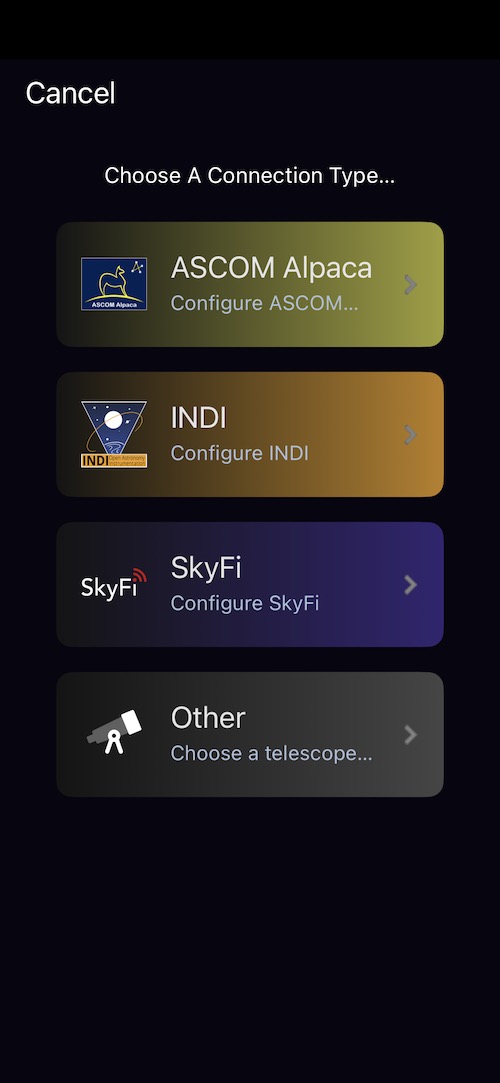
Select ‘Other’ as the telescope type.
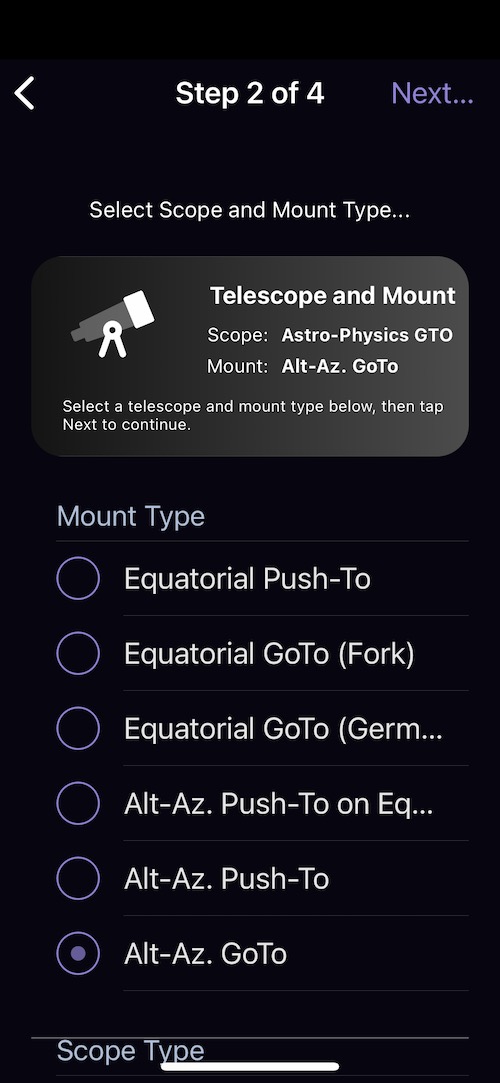
Select ‘Alt-Az. GoTo’ as the mount type, even if your telescope has no GoTo. The GoTo setting is what lets you send objects from SkySafari to the PiFinder’s observing list.
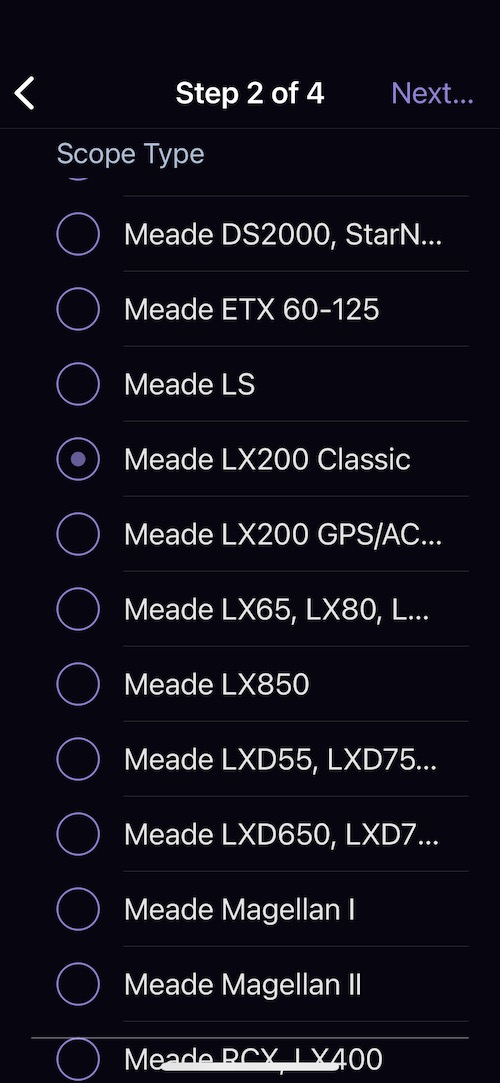
Select ‘Meade LX200 Classic’ for the scope type, then select ‘Next’.
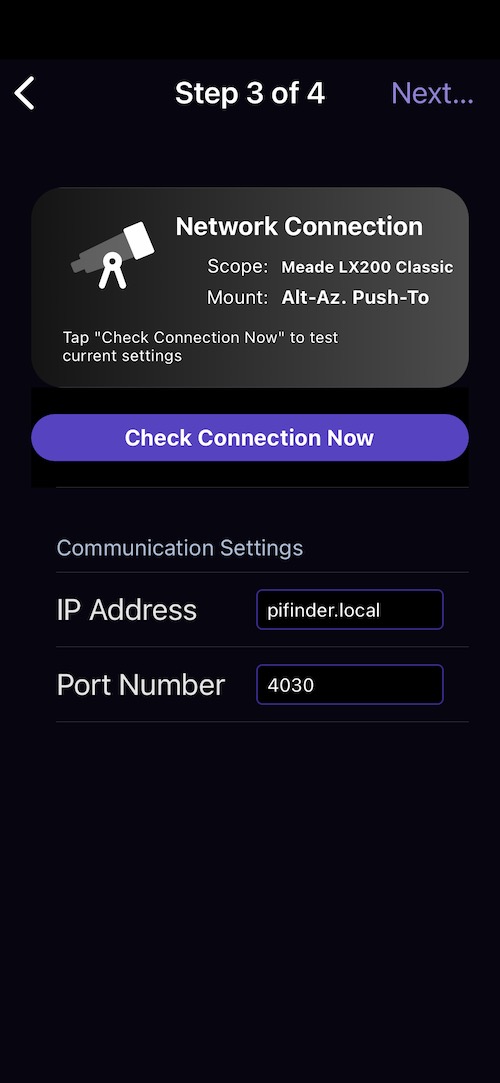
Use pifinder.local for the IP address. If that does not work, check the Status screen for the numeric IP address. Set the port to 4030, the SkySafari default.
Select ‘Next’ to continue.
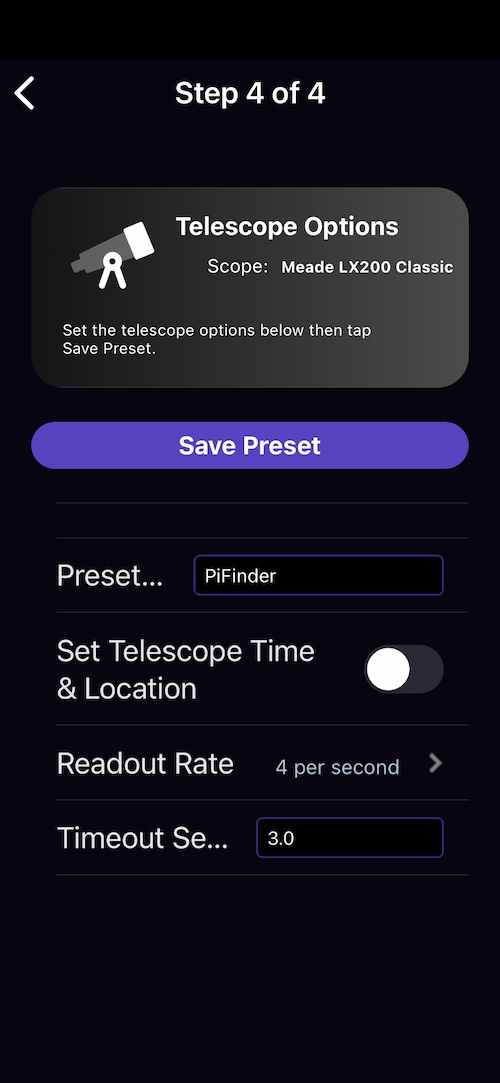
The default Readout rate and Timeout are fine. Name your profile, then select ‘Save Preset’ to save it and make it active.
Now select the Telescope icon on the main SkySafari screen and connect. SkySafari then receives position updates from the PiFinder. Until the first plate solve completes, the PiFinder sends a default location (0 degrees RA/DEC).
Using SkySafari
After you connect, SkySafari and the PiFinder work together in two main ways:
Follow your telescope on the star chart. As you move the telescope, the PiFinder reports its solved position and SkySafari marks that position on its chart. The chart gives you a large, zoomable view of where the telescope points. This is most useful near the zenith, where the PiFinder’s own Push-To numbers become unstable.
Send objects to the PiFinder. Select an object in SkySafari and send it to the PiFinder’s observing list, then use Push-To guidance to find it. This is more comfortable than entering objects with the keypad.
A few things are worth knowing about the connection:
SkySafari does not command the PiFinder to slew or auto-center a GoTo mount. The connection reads out position and sends objects. GoTo control is in development.
Only one app can connect to the PiFinder at a time. To connect from a different phone, tablet or computer, disconnect the first.
The PiFinder cannot connect to SkySafari and a GoTo mount at the same time. Use one or the other.
Note
If the PiFinder enters power-save mode, it stops sending position updates. SkySafari then appears to freeze. When you rely on SkySafari, lengthen the sleep timer or turn it off. See Adjusting Brightness.
Stellarium
Stellarium connects to the PiFinder the same way SkySafari does. It uses the same LX200 protocol and the same port, so the network setup above applies unchanged.
In Stellarium’s telescope settings, add a telescope and select a Meade LX200 compatible type.
Use pifinder.local for the address. If that does not work, check the Status screen for the
numeric IP address. Set the port to 4030.
After you connect, Stellarium marks the telescope’s position on its star chart. You can also select an object in Stellarium and send it to the PiFinder’s observing list, then use Push-To guidance to find it.
Note
Stellarium sends the PiFinder its own observing site and clock while it connects. The PiFinder accepts them and then keeps using its own GPS position and time. Your observing location does not change.
The points under Using SkySafari apply to Stellarium as well. Only one app can connect at a time, and the PiFinder stops sending position updates in power-save mode.
Troubleshooting
SkySafari won’t connect, or the connection keeps dropping.
The usual cause is your phone or tablet leaving the PiFinderAP network. That network has
no internet access, so many phones and tablets switch back to cellular or a home network in
the background. This breaks the link. Select PiFinderAP again in your WiFi settings, and
turn off any “smart network switching” or “auto-switch to mobile data” option.
``pifinder.local`` doesn’t resolve.
Some phones and networks cannot reliably look up the .local name. Use the PiFinder’s
numeric IP address instead. The Status screen shows it. In Access Point mode that address
is 10.10.10.1.
It connects, but the position never updates. Until the first plate solve completes, the PiFinder reports 0°/0°, so give it a moment with the camera focused on the sky. If the position updated and then froze, the PiFinder is most likely in power-save mode. See the note above.
The connection is intermittent at a star party. Two nearby PiFinders using the same network name (SSID) can interfere with each other. Give each one a distinct network name to avoid this.